%20(1)_edited.jpg)
Silver Surfer: How Momentum Investors made the most of Silver’s boom and bust !

2025 was a very eventful year for commodities. While the Indian stock market struggled in an extreme choppy phase since the hike in capital gains taxes by Honourable Finance Minister in the 2024 budget, Trump’s tantrums and geopolitical uncertainties created by them led to a significant rally in commodities like Gold, Silver and Copper.
In this article, we are going to analyse how a momentum investor could have traded silver, which was the most talked about commodity of 2025 using it’s price and volume chart.
Let’s start with the basics.
How can one trade in silver from India?
Let’s get one thing clear first, silver, unlike gold is not the best store of value. It isn’t as scarce as gold. However, it’s industrial applications mean that the prices can be very volatile. Below is the long-term chart of Silver/USD.

From the above chart, following observations can be made:
1. The price of silver had zero appreciation between it’s peak in 1979 to it’s breakout in 2025. Zero returns for 46 years.
2. Prices can be extremely volatile, after it’s peak of $48 per ounce in 1979, it fell to a low of $3.5 per ounce in 1991. A decline of 93%.
3. It can trend very well when it gives a breakout.
This means that while Silver has historically not been a great long-term investment, but it is a great tradeable security.
So, how does one trade in silver from India?
There are 3 main ways one can trade in silver:
1. ETFs (Exchange Traded Funds)
ETFs of Silver are offered by multiple AMCs like SBI, Nippon, HDFC etc. These ETFs can be bought and sold on NSE and BSE just like any stock. However, ETFs have some significant limitations:
a. Trading hours: They trade between 9:00 AM to 3:30 PM. Most price changes in silver happen during US market hours, while ETFs can't be traded during that period leading to significant risks. E.g. If the price of silver crashes by 20% at 9 PM, you won't be able to sell it before 9:00 AM next day.
b. Tracking error: During periods of significant volatility, prices of ETFs can significantly deviate from it’s spot prices. Which means that ETFs can become significantly expensive when you want to buy and significantly cheaper when trying to sell. This is due to liquidity issues mostly.
2. Futures on MCX
MCX (Multi Commodity Exchange) offers futures trading on commodities for Indian traders and it does away with the limitations of ETFs.
a. MCX is open from 9 AM to midnight, significantly reducing overnight risk.
b. Tracking error on MCX futures is much lower due to better liquidity.
However, futures trading too carries it’s unique risks which are:
a. Leverage: Leverage can amplify your returns but also your risk. And it is a human tendency to overestimate returns and underestimate risk due to greed. Whenever trading a leveraged instrument, risk management needs to be tight as a drum.
b. Large lot size: Lot sizes of commodity futures are generally much larger. SilverM (Silver Mini) is 5kg while Silver contract size is 30kg. This makes futures trading extremely risky for anyone with a capital of less than 30-50 lakhs. Even then, it is advisable to trade in Silver Mini contract due to better liquidity.
c. Margin changes during high volatility periods: During high volatility periods, MCX increases it’s margin requirements which can lead to sudden liquidation of positions.
3. MCX Options
Some traders prefer options over futures due to lower capital requirements, however, options bring in a lot more complexities into a trade due to time decay, volatility and strike prices and hence, is not recommended unless you are an expert options trader.
The Move:

The above chart of Silver/USD shows how Silver moved up by over 300% in 2025, before crashing by almost 50% within days in 2026.
While anyone who claims they bought at the bottom and sold at the top is either a liar or a time traveler, we are going to analyse how a trend follower could have captured most of the gains while staying out from most of the decline part.
Let us now understand how a momentum trader would have captured the Silver move while evading the crash.
1. Understanding the instrument
Whenever you go to trade any security - stock, crypto or commodity, it is important to first understand how it moves. Just like human beings, prices also have nature. Like if a human being has been greedy and manipulative, you can assume that he will be greedy and manipulative in the future too, with certain exceptions. Similarly, before trading any security it is important to understand the nature of the security. How does it behave before it makes a move, how does it behave during the move and how does it behave before reversing it’s move?
Let us now understand silver’s nature:
a. It tightens before making an upmove: Before making a good upmove, Silver, almost always goes tight, contracting in volatility.


So now we know we have to enter whenever Silver breaks out of a range after significant contraction in volatility.
b. It gives short-term moves while taking support at either the 10 or 21 day EMA


Now based on the above analysis of Silver, we can create the following rules:
When to enter
When to take a loss
When to take a profit
1. When to enter: Entry on Silver comes after it breaks out from a crucial pivot point after showing significant contraction in volatility. Either by forming smaller waves of correction or by forming tight range candles
2. When to take a loss: A good stoploss is when the price falls below the low of the tightness just before breakout
3. When to take a profit: This is the most difficult question to answer. Whether to sell into strength or into weakness. Both have their own pros and cons.
a. Selling into strength: This means selling when the price is still rising and your target profit is met.
Pros of selling into strength
i. No fear of reversal taking away your profit’s
ii. Psychologically easier
Cons of selling into strength
i. Can miss out on bigger moves
ii. Significant judgement involved
b. Selling into weakness: This means selling when a trailing stoploss is breached
Pros of selling into weakness
i. Rule based, so less judgement involved
ii. Capture big trends
Cons of selling into weakness
i. Sharp reversals can take away your gains
ii. Psychologically difficult to sit through pullbacks and see profit’s erode
The best solution? A combination of the two. Selling 1/3rd of half of the position when the trade gives you a return of 2 times your risk and selling the remaining position when either the 10 or 21 day EMA is breached (depending on where the price tends to take support).
Now let us analyse the trades that one could have taken. Do note that because of leverage involved in silver futures, profit’s and losses would be much bigger than the actual move in price.
1st Trade - 2nd June 2025

Silver had formed a clear VCP setup between March and May and contracted significantly in the last week of May. It broke out on 2nd June 2025. Here, one could have entered on an hourly close at 33.67 (price would have been different in INR Futures).
Stoploss would be placed below the contraction (which is also coinciding with the 10 and 21 day EMAs). The stoploss would be at 32.78. This gives a risk of ~3%.
Hence, we would sell half or 1/3 of the position at a profit of 6% (or at 35.7). This price was achieved 3 days later.
For the remaining position, one could have sold at the breach of the 10 day EMA (aggressive traders), or the breach of 21 day EMA (less aggressive traders). (Aggressive traders may also use the hourly chart to place their stoploss and trailing stoploss).
The 10 day was breached at 35.97 on 20th June while the 21 day EMA was breached on 30th July at 37.11.
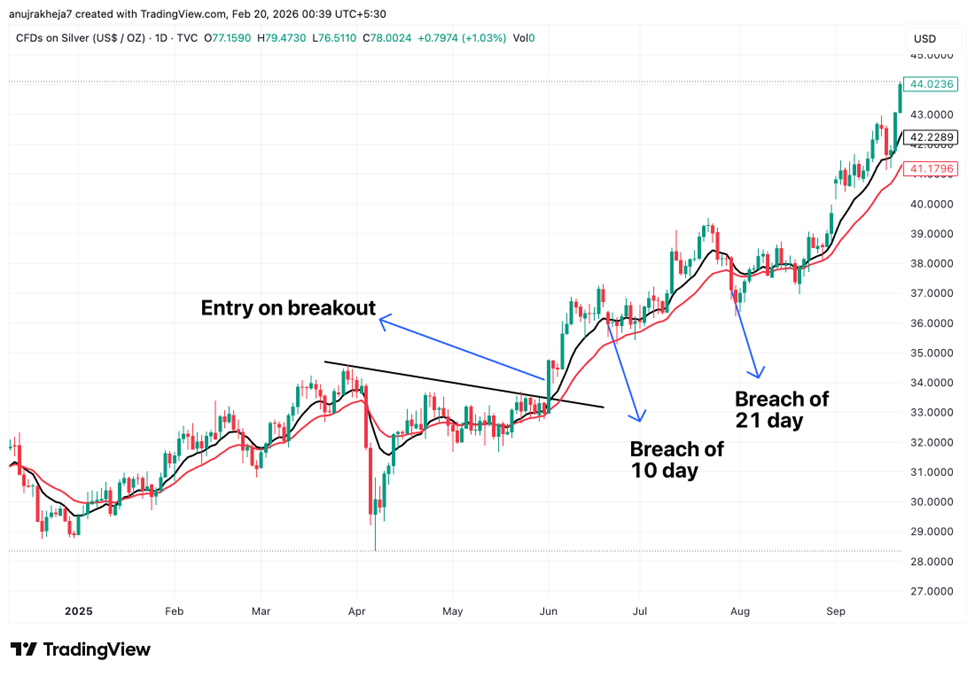
After this, silver went into a consolidation forming another VCP that lasted for about a month from 23rd July to 27th August 2025.

2nd Trade - 28th August 2025
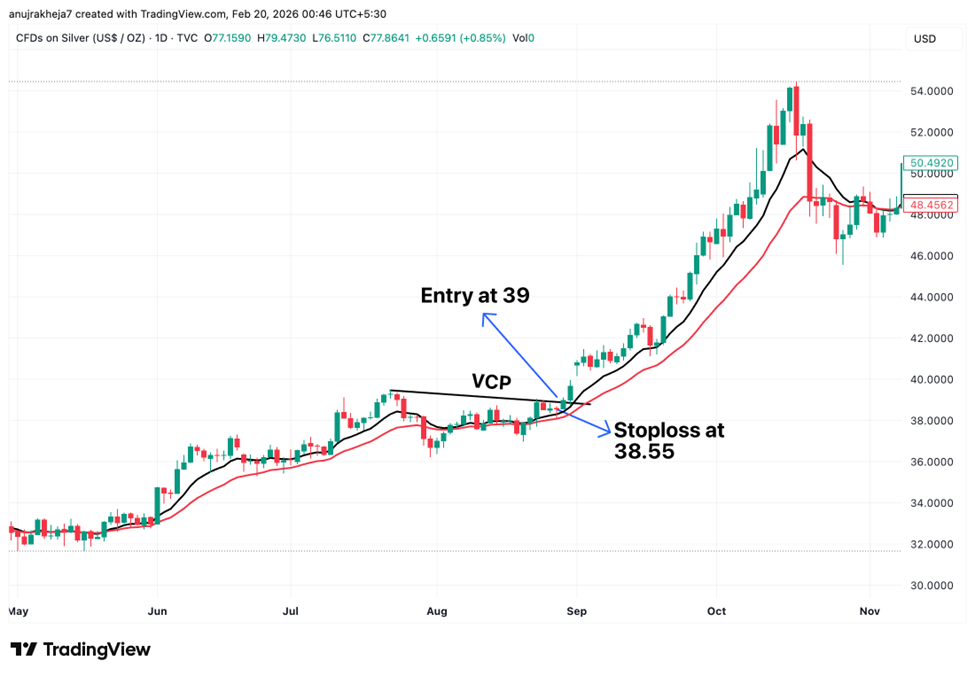
We would enter Silver again after it’s second VCP formation. This trade would have better confirmation because now we have a prior up move which means that institutions are accumulating silver.
The entry price of 39, with a stoploss at 38.55 means a risk of 1.2%. Making the first target to sell 1/3 at 2.4% profit or 39.94. This was achieved 2 days later. The remaining position can now be trailed using an appropriate moving average.
Post this breakout, silver moved significantly while taking support at the 10 day EMA. It gave a massive 38% move without breaching it. Do note that with an initial risk of 1.2%, one could have taken a significant position in this trade at minimal risk.
The price finally breached it’s 10 (and 21 day) EMA on the same day, closing at 48.5, giving an eventual return of ~25% from entry.
One question that might come to your mind is - Why not sell when the profit was at 38%? The answer is simple; hindsight is always 20/20. In real time, you need to have rules and ignore noise. In this case, our rule was to exit the trade when the price closes below the 10 day EMA.
Another question that might come to your mind - Silver went on to breach $120 per ounce, why sell at 48? Why not capture the whole move? The answer remains the same, hindsight is always 20/20. If anyone knew with certainty that Silver will hit $120 per ounce, they could have mortgaged their house and bought silver on leverage to make tens of crores in a few months, but nobody knew that.
Further, you can always re-enter if it sets up and breaks out again, but if it keeps falling, you will end up losing well-earned gains.
I give this analogy to my students when they ask me this question - Think about it, what would hurt you more? Holding a stock that falls down 90% or not buying a stock that went up 500%? I would rather be out of a trade, hoping I was in, than being in a trade, hoping I was out.
The move of Silver didn’t end there, it formed another VCP/Cup with handle between October and November.
3rd Trade - 26th November 2026

Silver broke out of a VCP pivot point on 26th November giving an entry at 53.38, I also shared this breakout with my students on our Telegram Channel. Stoploss would be placed below 51 at 5%, giving the first target at 10% or 58.7.

The first target was achieved 2 days later, where you could sell 1/3 of the position.
The rest of the trade can be trailed using the 10 day EMA (given that we now have evidence that silver is taking support at the 10 day EMA during it’s move).

After this breakout, Silver went from 53 to 120, a whopping move of 130%.
Now comes the interesting part, when a move like this happens, you want to sell before the price crashes, because waiting for breach of trailing stoploss can lead to a significant erosion of gains.
How do you do that? Two words - Exhaustion Move.
I shared the imminent crash with my students on our Telegram group a few days before the price crashed by over 30% in a single day, this was the sign to book most gains.

Let us understand what is an Exhaustion Move.
You must have heard of the saying- "A candle flickers the brightest before it goes out." Or it’s hindi version, "Diya bujhne se pehle zyada fadfadata hai." It is the same with prices of shares and commodities, after the price has been trending up for months, before it goes down, it can give it’s strongest moves. This strongest move is called an exhaustion move.
Another sign of an exhaustion move is when all retail investors around you want to invest in the share/commodity. Because retail investors are almost always the last buyers whom institutions sell to. When everybody wants to buy, there are no more buyers left and only sellers can come in.
I noticed this pattern in the DMs I received from followers. I was flooded with questions around how to buy Silver in the last 10 days of January, this was my sign to get out while I could without waiting for the trailing stoploss to get breached.
I and many of my students also managed to capture a decent move in Copper and Gold using these principles we learnt above.
Conclusion
1. Gold is a great long-term investment, Silver is a great tradeable commodity
2. While trading, buy when risk is low, and direction is up not when price is falling or when price is extended
3. Always keep a stoploss when trading in something volatile
4. Understand the nature of price of an instrument before trading in it
5. Leverage is a double-edged sword, must be managed very, very, very strictly, if you cannot, then avoid leverage altogether.


Comments